

Why and When to Use a Weight Distribution Hitch
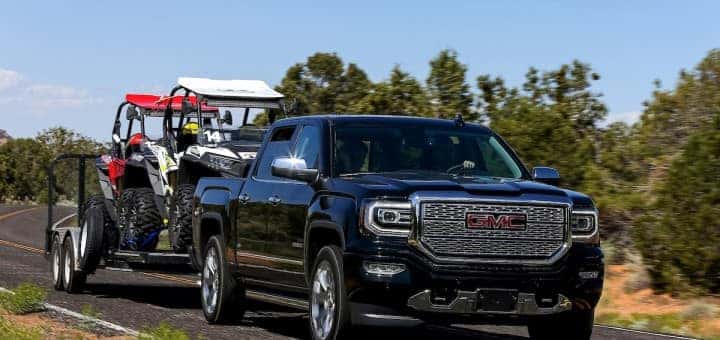
If you do any towing, you tend to notice other people towing as well. In which case, you have seen it. Someone pulling a trailer that is noticeably sagging at the hitch. The trailer is tipped upward in the rear, and the tow vehicle is too low in the rear and too high in the front. Penz Buick GMC of Rochester wants you not to be that guy. That situation not only looks bad but is unsafe. If the rear of the two vehicles is being forced down, the weight is being lifted from the front. This reduces traction to the steering tires and makes the front brakes less effective. At the same time, the two vehicle’s rear axle is being overloaded, reducing suspension travel, creating possible heat issues, and putting a burden on the rear brakes. Overall, the vehicle is significantly less stable, at a time when stability is paramount.
It may appear that the vehicle is pulling a trailer over its maximum towing capacity, but it may instead be excessive tongue weight, which is the actual amount of the trailer weight at the trailer hitch. Most trailers towed with a ball hitch should have a tongue weight that’s 10-15% of the total trailer weight. Below 10% can cause sway and stability issues, while above 15% can potentially overload the tow vehicle’s rear axle and lighten the front.
A trailer with a fixed load, like a camping trailer, was likely designed with a tongue weight in this range, and their tongue weight is usually specified. However, trailers with variable contents such as cargo, vehicles, or even livestock, where both the weight and distribution vary can give no such figure. Once a trailer gets heavy enough, the solution, at least on a body-on-frame pickup like the GMC Sierra 1500, is a weight distribution hitch (WDH).

What Does a Weight Distribution Hitch Do?
Alex Dykes of Alex on Autos once described weight distribution hitches as “poorly understood, absolutely essential, and seldom used”. They are designed to distribute the tongue weight evenly across the tow vehicle’s front and rear axles as well as to the trailer axle(s), by forcing the hitch connection to be parallel with the road. The industry term for this is Front Axle Load Restoration (FALR), and the goal is to return 50-100% of the weight lost from the front axle.
A WDH accomplishes FALR by the use of a more complex hitch that uses a height adjustment and a pair of spring bars. One end of each spring bar mounts to the trailer hitch on each side of the hitch ball th either end to each side of the trailer’s A-frame at about 23 to 35 inches from the coupler. The spring bars effectively reduce the vertical pivoting at the hitch ball. Almost like a splint, they force a parallel connection between the tow vehicle and trailer. This enacts a load on both the tow vehicle and trailer frame that creates a distribution of force to the front of the tow vehicle and the trailer’s axle(s). The spring bars are essentially torsion bars that will bend with enough force to enable turning and allow a significantly reduced level of vertical articulation to account for uneven surfaces while always returning the coupling to a position parallel to the road.
Considerations and Limitations
A WDH does not increase the vehicle’s maximum towing capacity and should only be used within that figure. Also, keep in mind that a vehicle equipped with rear air springs may level the vehicle but still not properly redistribute the weight.
WDHs require more setup than a conventional hitch. Hitch height must be determined and set, and there are settings for the spring bar mounting as well. And all this should be determined when both the tow vehicle and trailer are level. If your trailer load doesn’t vary much, again, like a camping trailer, you can pretty much set it and forget it. But if the trailer load changes, it will need to be set again.
Because the spring bars increase the load on the vehicle frame, they should only be used on “truck-based” body-on-frame vehicles. In the case of GMC, that includes all the pickup trucks and the Yukon and Yukon XL SUVs. “Car-based” models with unitized body frames, such as the GMC Acadia, Terrain, and all Buick SUVs, should not use weight distribution hitches as the frame loading can cause body integrity issues. Most trailers with surge brakes are also not compatible with at least chain-style weight distribution hitches.
When to Use a Weight Distribution Hitch?
It stands to reason that the heavier a trailer is in relation to the weight of the tow vehicle, the greater possibility.. As a general rule of thumb, you should consider using a WDH when the trailer weighs 50% or more than the tow vehicle. This would apply to Sierra HD vehicles as well.
In the case of a GMC Sierra 1500, its weight ranges from approximately 4,440 to 5,780 pounds, so the rule of thumb would recommend a WDH for a trailer weighing about 6,600 to 8,600 pounds, depending on your model. Because that assumes a tongue weight of 10 to 15% of the trailer weight, front-heavy trailers should have a lower weight threshold.
Most weight distribution hitches cost between $250 to $500. And while that is certainly more than a conventional hitch, it is a fraction of your tow vehicle and trailer cost, both of which will be better protected by more table towing. You will find the increased setup work well worth having a more stable tow experience. If you have any specific questions about towing with your GMC truck, or, you’d like to order one and have us install it for you, ask one of our professionals at Penz Buick GMC of Rochester.
0 comment(s) so far on Why and When to Use a Weight Distribution Hitch